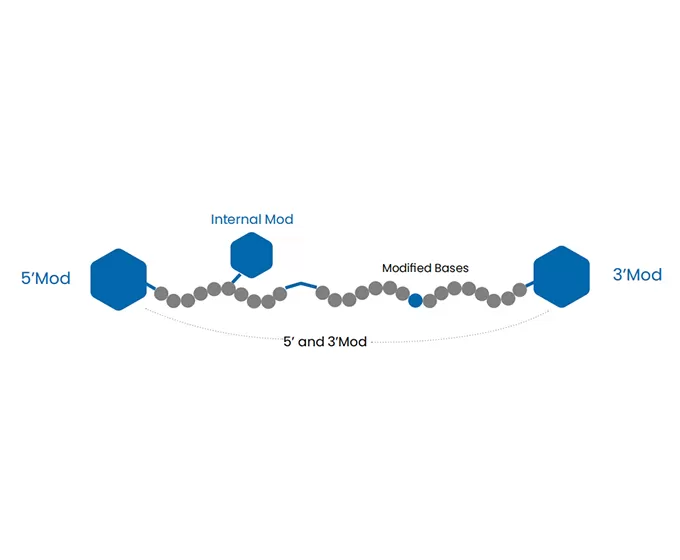
Oligo modifications are chemical alterations made to synthetic DNA or RNA to enhance their stability, function, or detection. Essential for molecular biology, diagnostics, and therapeutics, these modifications allow custom-tailored oligonucleotides for specific applications. Tsingke offers extensive modification options—including fluorophores, quenchers, modified bases, and linkers—with regular new additions to support advanced research. Our experts provide consultation to optimize modification strategies, ensuring successful outcomes in qPCR, sequencing, antisense therapeutics, and probe design.

From standard labels to complex conjugates.

Optimized coupling efficiency for high yield.

Research to GMP-grade production.

Serving scientists and industry worldwide.
| Modification type | Explanation | Key applications |
| Fluorescent Modifications | These modifications confer optical properties to oligonucleotides, enabling highly sensitive detection and quantification. By covalently linking fluorescent reporter groups (fluorophores) and corresponding quencher groups to oligonucleotides, various functional fluorescent probes can be constructed. | qPCR probes (e.g., TaqMan® probes, MGB probes), genotyping probes (e.g., SNP genotyping), STR detection probes, and molecular beacons. |
| Affinity and Capture Tags | Used for immobilizing, purifying, or isolating specific molecules—including amino modifiers, biotinylation, and thiol modifications—these tags function by selectively binding to complementary ligands, enhancing affinity and streamlining processes such as detection and functional analysis. | Protein interaction studies, EMSA probes, functionalized chips. |
| Modified Bases | The incorporation of modified bases—such as 2′-OMe, 2′-MOE, methoxyethyl, and fluoro bases—improves cross-linking, duplex stability, and nuclease resistance. | Antisense oligonucleotides, siRNA, and nucleic acid aptamers. |
| Backbone and Linkage Modifications | These modifications alter the natural structure of oligonucleotides to enhance nuclease resistance and stability in biological environments. The changes also enable precise conjugation with targeting molecules and improve pharmacokinetic properties, making them essential for developing effective therapeutic oligonucleotides and functional biomaterials. | Therapeutic oligonucleotides, delivery system conjugation, and site-specific cleavage. |
| Spacer Modifications | Spacers are incorporated to introduce flexibility and distance between functional groups and the oligonucleotide hybridization region. These inert molecular linkers reduce steric hindrance, enhancing the efficiency of attached moieties such as dyes or affinity tags. | FRET optimization, structural biology studies, and steric hindrance reduction. |
Synthesis: High-throughput synthesizer from pmol to mmol levels.
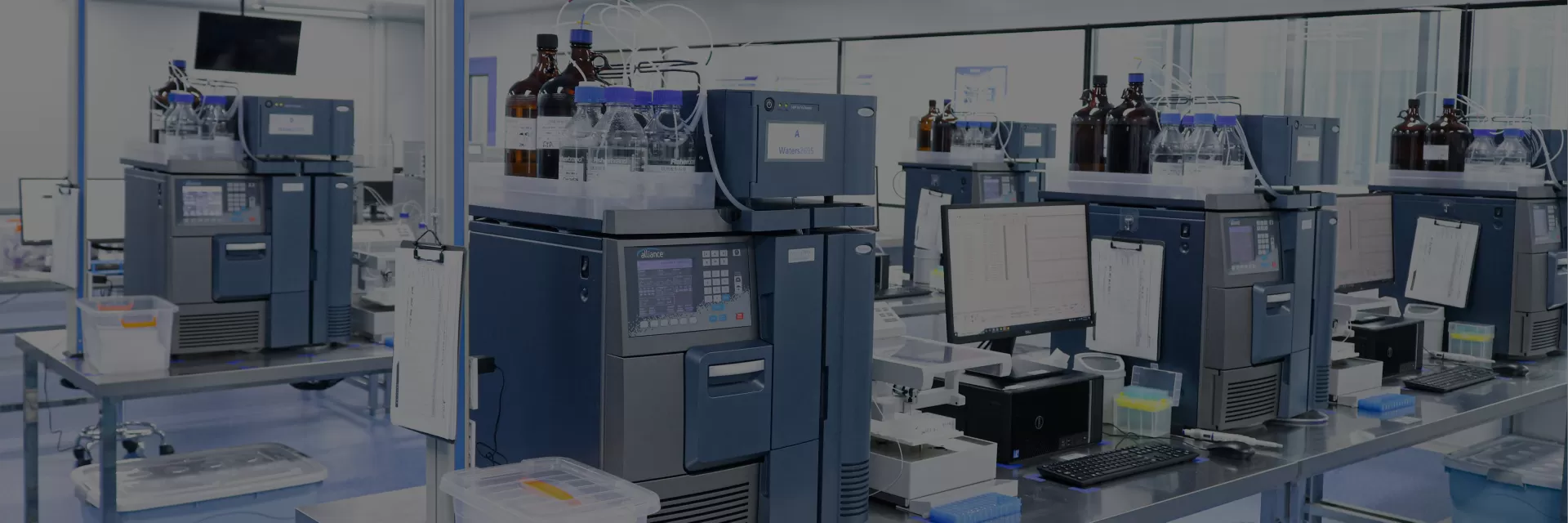
Purification: Waters 2695 & Waters 2767 automatic purification or HPLC purification.
QC: All mass quality inspection, HPLC, CE and other additional quality inspections.
Distribution: Automatic dispensing instrument for accurate dispensing.
Delivery: Tube or Customized、Lyophilized DNA or RNA、COA Report.
The common purification methods are PAGE and HPLC.